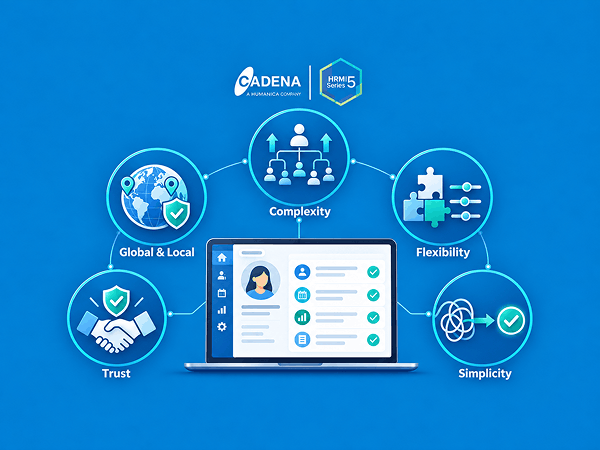
What 20+ years of working with multinational companies has taught us
Five lessons from the field, drawn from two decades of regional HR and payroll implementation.
Supporting multinational organizations as HR and payroll grow across borders.
Humanica Group is present in Thailand, Indonesia, Singapore, Malaysia, the Philippines and Vietnam.
What we have learned from solving the same challenges across industries and countries.
Where complexity begins
Twenty years of supporting multinational organizations has shown us that HR and payroll become increasingly complex as businesses grow across borders. It's rarely just about managing a larger workforce. More often, it's about navigating different regulations, payroll requirements, and local compliance across multiple markets.
Throughout this journey, we've learned that successful HR technology isn't defined by the longest feature list. It's built on flexibility, local expertise, and the ability to adapt as businesses and regulations evolve.
Most importantly, we've learned that experience matters. After solving the same challenges across industries and countries for more than two decades, you begin to recognize where complexity arises, and how to help organizations stay ahead of it.
These experiences have shaped not only our solutions, but also the way we partner with our customers.
Here are five key lessons we've learned from the field
HR complexity grows faster than headcount.
Complexity rarely scales in proportion to employee count. Each new entity or market tends to add exceptions faster than headcount alone would suggest.
A company that grows from one country to three doesn't simply triple its HR workload. Each new entity brings its own payroll calendar, statutory contributions, leave rules and approval flows, and every exception has to live somewhere.
When those exceptions are scattered across spreadsheets and separate systems, HR becomes the human integration layer, reconciling data by hand before every cut-off. That is why Cadena HRM Series 5 starts from Core HR: one employee record that every other process, from attendance to payroll, builds on.
Global consistency and local compliance must go hand in hand.
We've seen many organizations default to a single global template, only to find compliance breaks down at the local level. The ones that succeed treat local variation as a design requirement from the start.
Standardizing everything gives headquarters a clean report and local teams a compliance problem. Customizing everything gives each market what it needs and leaves headquarters without visibility.
The organizations that get this right decide early what must stay consistent (data, definitions, controls) and what must stay local (statutory rules, pay elements, reporting formats). It is the thinking behind supporting local and global payroll in one ecosystem, backed by Humanica Group's teams across six Asian markets.
Flexibility matters more than having hundreds of features.
Across the markets we've worked in, feature count rarely predicted success. What mattered was whether the system could bend to how a team already operated.
A long feature list is easy to compare in a spreadsheet and hard to live with. What teams actually experience is whether the system fits the way they already schedule shifts, record time, approve leave and pay allowances, and whether it can change when the business or the regulation does.
So in every project we begin with how the team operates today, not with a tour of every module.
Experience builds trust beyond feature lists.
A demo can show what a system does in an hour. Trust, in our experience, comes from having seen the same problem enough times to know where it usually breaks.
After enough implementations, patterns repeat: exceptions that were never documented, data that lives in too many places, approvals that only work because one person remembers them.
Knowing where these usually appear lets us raise them in the first workshop rather than in the last week before go-live. That foresight is what two decades of regional HR and payroll work gives a customer, and what a demo cannot.
Great HR technology should make complexity feel simple.
The clearest sign of a system working well, in our experience, is that people stop thinking about it. That shift is what we aim for in every implementation.
Simplicity is not fewer capabilities. It is complexity absorbed by the system, so that employees can check their leave balance without asking HR, managers can approve in a few taps, and HR can close the month without late nights.
For HR teams, the real return is time: time to focus on hiring, development and acting as a strategic partner to the business.
From lessons to product
Lessons only matter if they change how a product is built and how a project is run. Here is how these five show up in Cadena HRM Series 5.
A partnership built on experience
What we have learned has shaped how we work with customers: listening first, treating local variation as a design requirement, and staying close as businesses and regulations evolve.
If your organization is growing across markets, we would be glad to compare notes. Learn more at cadena-hrmseries.com.